JDO Vol. 78
Editorial
Chris H. Chang
Mission Impossible
Steve Jobs once said, “You did the impossible because you didn’t know it was impossible.” Had you known it was impossible, you might never have dared to try.
When my young colleague, Dr. Lee, proposed a study investigating the effect of buccal shelf bone screws on distalization of the lower dentition, I immediately recognized the value of the project. The challenge, however, was clear: the number of variables involved would make meaningful analysis difficult. Dr. Lee addressed this problem with an elegant solution. By dividing the patients into several groups, he substantially reduced the confounding variables—an approach reminiscent of the Roman strategy: divide and conquer.…

Conservative Treatment of a Skeletal Class II Malocclusion and Overjet Using Clear Aligners
Nawal J. Almutawa, Vicky Y. Huang, Chris H. Chang, W. Eugene Roberts
History: A 42-year-old female presented for orthodontic consultation with a severe skeletal Class II malocclusion, anterior crowding, overjet of 7 mm, dental Class II molar and canine relationships on both sides. The chief complaints were poor esthetics and an uneven smile.
Diagnosis and Etiology: The patient presented with a narrow upper arch, constricted 1st molars and premolar area, retroclined upper incisors, and crowding, with overjet of 7 mm. On the lower arch, there was mild crowding. Molar and Canine relationships were full-cusp Angle Class II malocclusion on both sides. However, cephalometric analysis showed a skeletal Class II relationship with a straight profile. The increased overjet is probably due to external factors, including childhood thumb-sucking and ongoing habits such as mouth breathing and tongue thrusting. These behaviors contribute to the narrowing of the upper arch. A skeletal retrognathic mandible was noted. A high mandibular angle (FMA, 37 ̊) led to a hyperdivergent facial pattern, increased overjet, and Class II malocclusion.
Treatment: A non-surgical orthodontic treatment plan utilizing clear aligners and elastics has been created. A thorough pre-treatment evaluation was conducted, including digital impressions taken with the iTero Element II scanner. All necessary records and the prescription form were submitted for the comprehensive Invisalign clear aligners. Extraction of upper third molars on both sides were performed prior to arrival of the aligners. A set of 61 aligners was prescribed. After one week, at the second visit, attachments where bonded, and early Class II elastics were used. The patient was appointed every 4 weeks, with 7-day intervals between aligner changes. Upon finishing the aligner treatment, we observed substantial improvements in the overjet and overbite, as well as achieving Class I molar and canine relationships on both sides. Retention was maintained using clear retainers. (J Digital Orthod 2026;78:4-23)
Outcomes: Treatment goals were achieved after 18 months of treatment with clear aligners.
Key words: Class llI malocclusion, Class llI molar relationship, open bite, crossbite, Class Ill elastics, overjet, overbite
Download Article
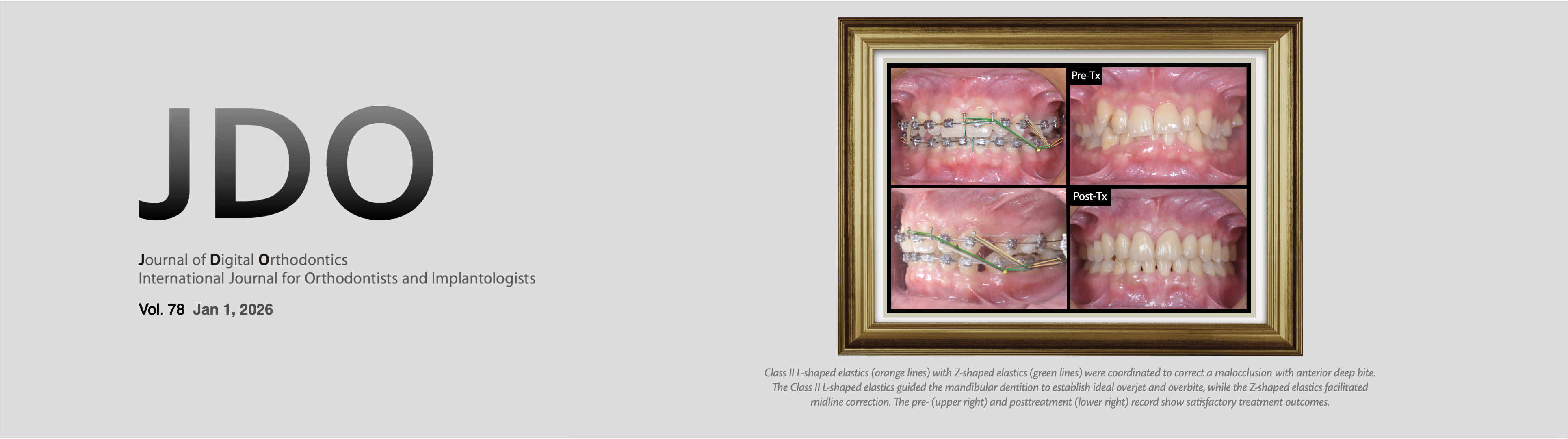
Management of Anterior Deep Bite and Posterior Crossbite with a Reengineered Self-Ligating Bracket System: A Four-Premolar Extraction Case
Lily Y. Chen, Joshua S. Lin, Chris H. Chang, W. Eugene Roberts
A 24yr-5m-old male presented with skeletal Class II relationships (ANB = 6˚), severe crowding, deep overbite, posterior crossbite, and mandibular midline deviation. After 26 months of active treatment, the deep bite was significantly improved with leveling of curve of Spee. Treatment involved extraction of four premolars, combined with staged bite-opening strategies, including the use of posterior and anterior bite turbos (BTs), along with elastics to facilitate posterior occlusal settling and to achieve ideal overjet and overbite. A four-wall rigid orthodontic bracket system based on a reengineered self-ligating design was utilized to enhance torque control of anterior teeth and improve the efficiency of space closure. This case with a Discrepancy Index (DI) of 17 points was finished with a Cast-Radiograph Evaluation (CRE) score of 10 points and a Pink and White esthetic score of 3 points. (J Digital Orthod 2026;78:28-46)
Key words: Skeletal Class II, severe crowding, deep bite, posterior crossbite, midline deviation, anterior bite turbo, posterior bite turbo, four premolars extraction, Damon UltimaTM
Download Article
A Two-Phase Clear Aligner Therapy for Bimaxillary Protrusion with Severe Rotation of Lower Left Second Molar
Joy Cheng, Chris H. Chang, W. Eugene Roberts
History: A 24yr-1mo-old male presented with a chief complaint (CC) of crooked teeth.
Diagnosis: The patient was diagnosed with bimaxillary protrusion combined with severe mesial-out rotation of LL7, and lingual crossbite of UL7. The Discrepancy Index (DI) was 9.
Treatment: Segmental fixed appliance combined with a ramus screw were installed to correct the severely rotated LL7 during the 6-month pre-aligner treatment. After the therapy, the rotation was successfully corrected. However, the side effect was extrusion of LL7, which resulted in poor occlusal contact that evolved into a posterior open bite during aligner treatment. Three stages of aligners (43, 18, and 15 sets respectively) were used to correct the bimaxillary protrusion, posterior open bite, and lingual crossbite of UL7.
Results: After 31 months of active treatment, this malocclusion, with a Discrepancy Index of 9 points, was treated to a Cast-Radiograph Evaluation (CRE) score of 6 points and a Pink and White esthetic score of 2 points. The patient was pleased with the treatment outcome.
Conclusions: Hybrid mechanics combining the strengths of fixed appliances and clear aligner therapy are effective in correcting bimaxillary protrusion and severe rotation of molars. (J Digital Orthod 2026;78:52-70; reprinted from J Digital Orthod 2021;64:4-22)
Key words: Clear aligner therapy (CAT), segmental braces, clear aligner, ramus screws, bimaxillary protrusion, non-extraction, temporary skeletal anchorage devices (TSADs)
Download Article